

On Rape
A patriarchal project

I read and write a lot about rape. I think it’s important for me to do so as a feminist, given that rape is a women’s issue. By “women’s issue”, I don’t mean that it is our issue to solve alone; rather, I mean that it is something that affects women globally and that we, as feminists, need to talk about and tackle.1 Despite its utmost importance, I do find it difficult to read and write about because it is a profoundly upsetting topic and reality. It is also widely misunderstood. We are not good at talking about or understanding rape. We use euphemisms to discuss it, we spread false information about what causes it and who commits it, and we often even debate whether acts of rape are “really” rape. All of this makes it incredibly difficult to find solutions to ending it.
Rape, in a non‑legalese dictionary sense, is defined as:
Unlawful sexual activity — usually sexual intercourse — carried out forcibly or under threat of injury against a person’s will, or with a person who is beneath a certain age or incapable of valid consent because of mental illness, mental deficiency, intoxication, unconsciousness, or deception.
An outrageous violation.
An act or instance of robbing, despoiling, or carrying away a person by force.
I find section 3 of this definition particularly striking, because rape does feel like being robbed. It robs women of their autonomy, their safety, and their sense of dignity, not metaphorically, but in a visceral, lived way that lingers long after the event itself.
The term originates from the Latin rapere (supine stem raptum), meaning “to snatch, to grab, to carry off.” In Roman law, raptus referred to the carrying off of a woman by force — with or without intercourse. The emphasis was not on the violation of the woman herself, but on the violation of the male guardian’s property rights. A woman’s body, her movement, her very presence in the world, was legally conceptualised as something that could be seized, transported, or appropriated. The etymology exposes the long historical lineage of rape as an act rooted in ownership and entitlement: the idea that a woman can be taken, removed, or claimed by male force simply because she exists within reach.
In French, the word for rape is viol, which sounds strikingly similar to violence. That proximity isn’t accidental: rape is a violent act. It doesn’t need to involve a weapon or even visible physical harm like a slap, kick, or punch — most rapes don’t look like that, and yet they are still violent. Penetrating or entering a body that is not your own, and that did not consent to your presence, is inherently violent. It is like entering someone’s home without knocking, without permission, without any right to be there. It is a profound violation of boundaries, autonomy, and bodily integrity — a violence enacted through access rather than bruises.
Rape is different from sexual assault, and it genuinely annoys me that the terms are used interchangeably. It’s important to distinguish them — not to minimise one or the other, but to ensure both are understood in their own right and addressed appropriately. Sexual assault is defined as an act of sexual abuse in which someone intentionally touches another person sexually without consent, or coerces or physically forces them to engage in a sexual act against their will.
This definition makes it understandable why people often confuse the two, because rape is ultimately forcing someone to engage in a sexual act (penetrative sex) against their will. However, the definition also includes other acts one can be forced into that are not rape. It’s complicated, I know, and many respected feminists and analysts use the terms interchangeably for various reasons — but I don’t. For the sake of clarity: if I’m referring to forced, non‑consensual penetrative sex, I’ll say rape; if I’m referring to non‑consensual sexual acts other than penetrative sex, then I’ll say sexual assault.
I also don’t like it when people say “grape” instead of rape, or “SA” instead of sexual assault — or instead of rape. It feels VERY online, very Gen Z, slangy, and honestly really fucking stupid. Why discuss rape if you can’t even name it? Euphemisms make the violence smaller, softer, easier to digest. They trivialize something that should not be. If the word itself is too confronting to say, then maybe the conversation isn’t being had honestly.
I think the term sexual violence is a good one because it functions as an umbrella term and encompasses a wide range of behaviours. The National Plan to End Violence against Women and Children 2022–2032 defines sexual violence as sexual activity that occurs when consent is not freely given or obtained, is withdrawn, or the person is unable to consent due to age or other factors.2 Sexual violence occurs any time a person is forced, coerced, or manipulated into any sexual activity. Such activity can include sexualised touching, sexual abuse, sexual assault, rape, sexual harassment and intimidation, and forced or coerced watching or engaging in pornography.
So one more time….. if I’m referring to rape, I’ll say rape; if I’m referring to sexual assault, I’ll say sexual assault; and if I’m referring to all of these, along with other forms of coercive sexual acts collectively, I’ll use the term sexual violence.

Rape, like most other forms of violence, is overwhelmingly committed by men, and the victims or recipients of this violence are most often women. Women are capable of violence, of course, but it is rare — especially when it comes to sexual violence.
Many people argue that women “can’t rape” because they don’t have a penis. Many legal definitions of rape still hinge on forced penile penetration of the vagina, anus, or mouth — and since women do not have penises, they are excluded from the definition by default. But women can rape other women and men through digital penetration or object insertion, even if this is statistically rare. And frankly, I’m happy to say that women cannot commit penile rape.
It is also worth noting that men are far more likely to be raped by other men than by women.
The psychology behind women who commit sexual violence — which is still being researched — appears to differ from the psychology of men who commit it. Personally, that makes me think this difference may be part of why female‑perpetrated sexual violence is so rare. However, I’m not making any assertions here, and this piece is not a “what about women who rape?” or “what about men who get raped?” detour.

Rape is a very scary and violent thing, but most instances of rape don’t look like the stereotype: a creepy man in a dark alley holding a knife to a woman’s throat. That image exists because it’s cinematic, dramatic, and thrilling. But rape is often far more “banal,” far more domestic, far more intimate. It can look like your boyfriend rolling over in bed, pressing his erect penis against you, asking you to “have fun,” and you say no, not in the mood. He says, “C’mon baby, I’m hard.” You say no again — seriously, I’m tired — and he responds with, “Don’t you love me?” as his hand slides down your knickers. You recoil, you say no, you don’t want to, but he holds you, kisses you, and starts to insert his penis anyway. Maybe you “give in” because he’s worn you down, or maybe you freeze because your body shuts down. That scenario is far more common. There’s no screaming, no hitting, no dramatic violence — just the simple, devastating reality of a man refusing to take no for an answer within the context of a “loving relationship.”
Another scenario: a girl you meet at a club. She’s extremely drunk — stumbling, eyes rolling back, vomit in her hair and at the corner of her mouth. You get into a taxi with her and take her back to your place. You lay her on your bed and start undressing her, touching her, penetrating her. She might be completely unconscious and unable to respond. She might be semi‑conscious but too intoxicated to understand what’s happening, too impaired to say no, or too confused to resist. She might mumble no, ask what’s going on, ask who you are, ask why you’re doing this — and she might still “give in” because she’s too intoxicated to fight. This, too, is rape.
Rape does not need to be loud, violent, or committed by a stranger in a dark alley for it to be rape. The defining feature of rape is the absence of consent. And yet, consent is one of the most poorly understood concepts, despite being thrown around constantly in serious conversations about sexual violence.
Consent is defined as permission for something to happen or agreement to do something. But for that permission to be valid, several conditions must be met. The person giving consent must know what is happening — they must be informed. That’s why we talk about informed consent. If you say you’re going to have penis‑in‑vagina sex with someone but do not tell them you also intend to penetrate their anus, and they only consent to vaginal sex, then their consent is not informed. If you proceed to penetrate their anus without asking, that is rape — especially if you do not stop when they object.
Consent is also a two‑way street. If only one person consents to the sexual act and the other does not, the act cannot and should not go ahead. All parties must agree. Consent can also be revoked at any time. If someone wants to stop in the middle of a sexual act — even if they agreed at the beginning — the act must stop. If it does not, and their withdrawal of consent is ignored or overridden, that is rape.
Another crucial point: a person must be in the right state of mind to give informed consent. People who are underage, unconscious, severely intoxicated, under the influence of drugs, or severely mentally disabled cannot give informed consent. So even if you ask the drunk girl at the club if she wants to “fuck you,” and her glassy eyes and lolling head nod yes, she is not in a position to understand what she is agreeing to. You should only be asking — and doing — these things when both people are sober.

Much like rape rarely occurs in a violent, eerie, depraved setting, most rapists are not “rape‑sick old men” who torture little girls and fashion their skin into lampshades. Most rapists are “normal” people. They hold jobs, have families, maintain friendships, are educated, and often have no criminal history or traumatic background. The stereotype of the deranged predator is comforting because it allows people to believe rape is committed by “monsters,” not by the men they know and love. But the reality is far more mundane — and far more disturbing.
There is no “male rape gene,” even though the animal kingdom and human history might make rape appear animalistic or a primal urge, much like sex. Rape is not innate to men. It is not a biological male quality. However, it is an act that can only be committed by men in the sense that it overwhelmingly is, and historically and socially has been, committed by them.
Most rapists are not sadists; they’re opportunists. These rapists commit rape impulsively when a situation presents low risk or an easy target — a girlfriend, a drunk girl at a party — rather than through elaborate planning. They often use minimal force, show little overt anger, and are likely to flee if the victim resists or makes a scene.
There are various typologies of rapists — the Barbaree typology, the Groth typology, the MTC typology, and others.3 Many overlap, often using different language to describe the same behavioural patterns.
Barbaree’s typology4 argues that most rapes are impulsive and opportunistic, committed by people who may also engage in other impulsive acts, including impulsive crimes. It categorises rapists as:
Power Rapist: Preoccupied with a fixed sexual fantasy they attempt to act out during the rape — for example, forcing a victim to have sex and then imagining the victim will fall in love with them. These rapists are the least aggressive and are most likely to flee if the victim strongly resists.
Vindictive Rapist: Commits physically harmful assaults with the explicit intent to degrade and humiliate the victim. (I would argue that all rape degrades and humiliates the victim, even if that is not the rapist’s conscious goal.)
Anger Rapist: Motivated by anger at the world at large. These rapists are likely to inflict the most physical damage and often have long histories of violent crime. This is the “stereotype” most people imagine when they think of a rapist.
Groth’s typology5 categorises rapists based on the goal of the assault:
Power Rapist: Uses rape to compensate for underlying feelings of inadequacy. Rape becomes a way to assert mastery, control, strength, authority, and capability. They rely on verbal threats, intimidation, and only the amount of force necessary to subdue the victim.
Anger Rapist: Aims to humiliate, debase, and hurt the victim. They express contempt through physical violence and profane language. For them, sex is a weapon; rape is the ultimate expression of their anger.
Sadistic Rapist: Experiences sexual arousal from the suffering of the victim. Sexual excitement is tied to causing pain, torment, distress, helplessness, and fear. The victim’s struggle is eroticised. This is the rarest but most extreme category.
Overall, rapists are typically ordinary, socially integrated men whose behaviour follows identifiable patterns, hostility toward women, entitlement, boundary‑testing, rather than fitting the stereotype of obvious criminals.
Germaine Greer argued that rape is not “spectacularly violent” and that “most rape is just lazy, just careless, insensitive.” Her point, blunt as it is, underscores the reality that rape is often not about elaborate cruelty but about male entitlement, convenience, and disregard.

I do not have a background in psychology, so I am not going to explore or comment on the anger‑ or sadistic‑rapist categories, nor on the possible neuroses, depravity, or psychological pathologies of these men. Instead, I will focus on the opportunist/power rapist, because their typology is driven, in my opinion, by our patriarchal society. Patriarchy has made the world inhospitable for women and girls. It makes life unsafe, oppressive, and violent. It ensures that women remain at the bottom of the social hierarchy while men sit at the top, endowed with a supposed divine right to own, control, subjugate, rape, kill, and oppress women. Women are given no legitimate right to resist; instead, they are taught to be small, meek, accommodating, and accepting of this treatment.
Men treat other men brutally as well — father to son, peer to peer, institution to individual. They enact violence on one another and then consciously and unconsciously reenact that violence onto women. Heck, why not direct it at women? Because men are taught to interpret women as the cause of their failures, their humiliations, their emotional wounds. Boys are also taught to suppress sadness, fear, tenderness, and vulnerability. They often need emotional support, but instead are pushed toward stoicism and aggression, which leaves them emotionally disconnected and therefore more able to dehumanise and violate women.
Many men are taught that sex is one of the only acceptable avenues for seeking closeness, relief, or emotional release. But because sex cannot actually meet those deeper unmet needs, the pursuit becomes frustrated, compulsive, and sometimes coercive. Rape grows out of patriarchal conditioning that wounds boys, teaches them emotional disconnection, grants them entitlement to women’s bodies, and channels their shame and rage into domination.
Andrea Dworkin, in Intercourse, argues that heterosexual intercourse has historically been structured by laws and institutions that made women sexually available to men — including the old legal doctrine that husbands could not rape their wives because they had a legal right to their wives’ bodies. She explicitly stated that this does not mean all intercourse is forced, but that the institution of heterosexual intercourse has been shaped by a coercive history.
Nothing women do, say, or wear causes rape. It is patriarchy that teaches men to blame women in order to justify their actions: It must have been something she did that made me lose control, that triggered this impulse. A woman can be in daggy pyjamas on the couch with her boyfriend and be raped. A little girl in a jumpsuit and pull‑ups can be raped by her grandfather while he babysits her. A girl in a singlet and short shorts can be raped by a man who takes her home from a club. Rape is a one‑sided act. There is nothing a woman can do to cause it or prevent it. It is entirely dependent on the man.
Yet this rhetoric — that women provoke rape — is used to further humiliate victims. They have already endured something utterly detestable, and then they are burdened with guilt: It was my fault. I provoked him. I was asking for it. This is compounded patriarchal abuse.
Although I disagree with some of Germaine Greer’s comments about rape and rape penalties, I respect her rejection of the idea that rape “destroys” a woman’s life. Of course rape changes a woman, and of course it is a horrific act that traumatises her. But as Greer argued, women are deeply wronged and humiliated — not annihilated. The insistence that rape “destroys” women can itself be a patriarchal narrative, one that frames women as permanently broken rather than harmed and still alive.
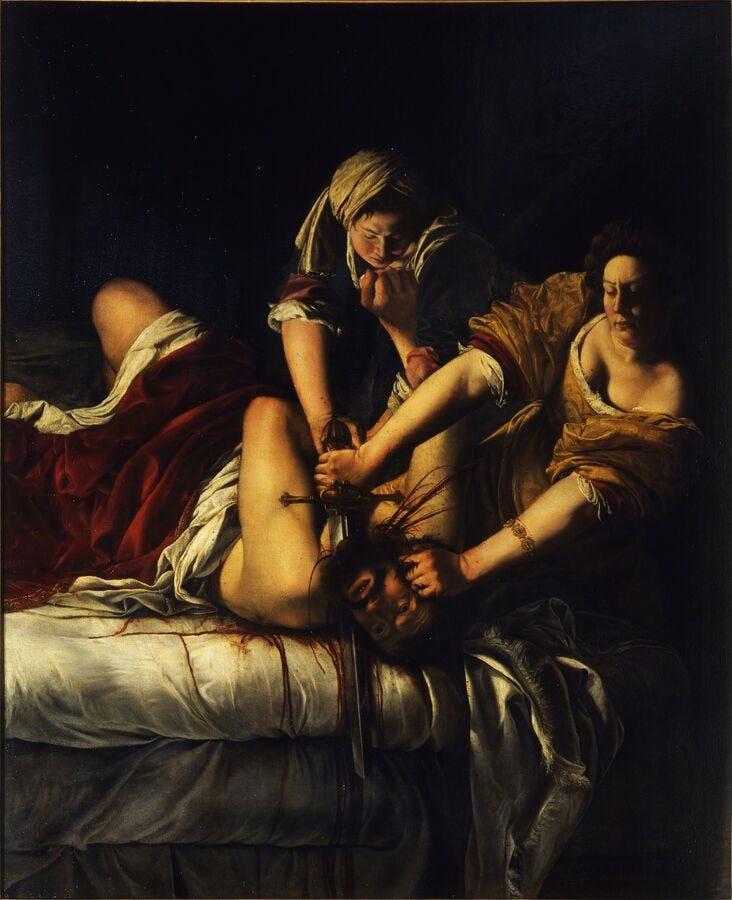
When I think about refusing to let rape destroy a woman, I think of Artemisia Gentileschi. I discovered her during my BA while taking an art history elective, and she has stayed with me ever since. Gentileschi was a renowned Italian Baroque painter — today one of the most iconic female artists of her era. I’ve featured her work in my writing many times, and for good reason: her paintings are exquisite, and they depict exactly what I am drawn to — strong women and female rage.
When she was seventeen, she was raped by Agostino Tassi, another painter hired by her father to tutor her. Her father brought the case against Tassi, leading to a very public trial in Rome in 1612. Artemisia testified, but she was subjected to torture to “verify” her testimony — apparently a common legal practice at the time. Tassi was eventually found guilty, but he received a light punishment. Artemisia, meanwhile, was humiliated. If you think society today is cruel to rape victims, if you think we live in a rape culture now, imagine Rome in the seventeenth century.
After learning about her rape, I assumed Artemisia — like so many “tragic” women in history — had thrown herself from a tower or drowned herself in a river. But no. Not Artemisia! She became a successful artist and channeled what happened to her into her work, most famously in Judith Beheading Holofernes. If you’ve read my work or other feminist writers on Substack, you’ll know we love that painting. She completed it when she was in her twenties. It depicts Judith beheading Holofernes, from the apocryphal Book of Judith, in which the Israelite heroine assassinates the Assyrian general Holofernes.
My feminist professor — like many others — interpreted the painting as a form of visual revenge following Gentileschi’s rape by Tassi. Holofernes becomes Tassi; Judith becomes Artemisia, beheading the man who violated her. It was considered unbecoming for a woman to paint violence, but honestly, fuck that. Artemisia was violated and brutalised — why should she be meek? Why should she remain silent? Why shouldn’t she name what happened to her and carve it into art?
More women need to speak up about rape — but that can only happen if more men and women meet them with compassion and support. Why wax poetic about whether your friend who was raped is “really telling the truth”? Why cock your brow when you hear that a woman has been raped? Why dismiss a female actress as “just another white #MeToo‑er” when she comes forward about being assaulted?
Instead of asking, How could such an evil woman lie about rape? ask yourself what you gain from believing that narrative. Who benefits from that belief system? I’ll give you a hint: the same system that made it possible — and acceptable — for women to be raped in the first place.
Please continue to hold Substack accountable for the misogynistic, racist, and sexual abuse of female readers and writers that they are enabling on this platform. When you see abuse under this piece, on my page, or on the pages of other women, screenshot it, report it, and block the account. Document it. Keep receipts. I’ve also shared a guide and a script you can use here.
World Health Organization. “Violence Against Women.” https://www.who.int/news-room/fact-sheets/detail/violence-against-women
Australian Institute of Health and Welfare. “Sexual Violence.” AIHW. https://www.aihw.gov.au/family-domestic-and-sexual-violence/types-of-violence/sexual-violence
Office of Sex Offender Sentencing, Monitoring, Apprehending, Registering, and Tracking (SMART). “Chapter 3: Sex Offender Typologies.” SMART Office. https://smart.ojp.gov/somapi/chapter-3-sex-offender-typologies
Ibid.
Groth, Nicholas. Men Who Rape: The Psychology of the Offender. New York: Plenum Press, 1979, 44–45. https://archive.org/details/menwhorape00anic_85x/page/44/mode/1up
I have always used the following principles when having sex, and I consider them universalisable:
No means No, and Stop means Stop.
Yes is contingent.
If in doubt, pause and check.
Respect your partner.
Every touch, from holding hands to just before orgasm, is contingent on agreement, which can be revoked at any time and for any reason.
At the beginning of a relationship, all intimate activity needs to be specifically checked with one's partner. One of the joys of getting to know one's partner is not having to specifically check everything.
Sex is part of a wider relationship, not a means to an end. Don't have sex with people you don't know or don't want to see again.
As far as I am aware, by treating my partners as autonomous human beings, I have never had non-consensual sex. I would be mortified to find out that I had.
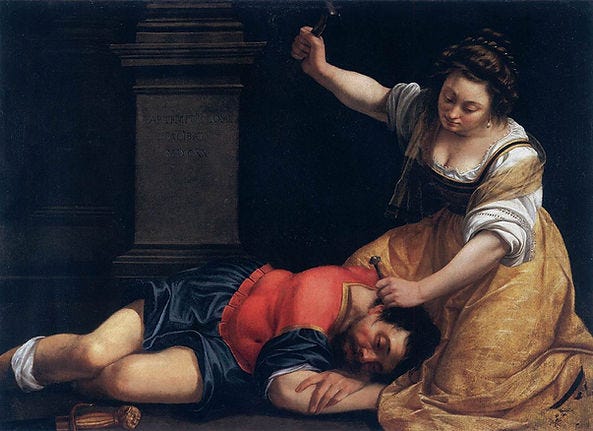
I recently learned of Yael, a woman described in the Old Testament Book of Judges, who killed a Canaanite warrior by striking him on the head with a hammer while he slept recovering from defeat by the Israelites. He didn’t get to rape her.